
Your hives hum in the early light, a sweet swirl of promise drifting around the corners of each frame. For many beekeepers like you, recognizing the signs of a healthy queen bee is a delicate blend of observation and intuition, where even the smallest details can tell an epic story of hive harmony.
Within that gentle buzz, the queen reigns like an invisible conductor. Her pheromones unify every worker, coaxing them into carefully orchestrated tasks, from feeding larvae to defending the entrance. In moments when you find her amidst the population, you notice how she sometimes seems shy but also both calm and commanding, a sure sign that the colony is thriving under her leadership.
Examine physical traits
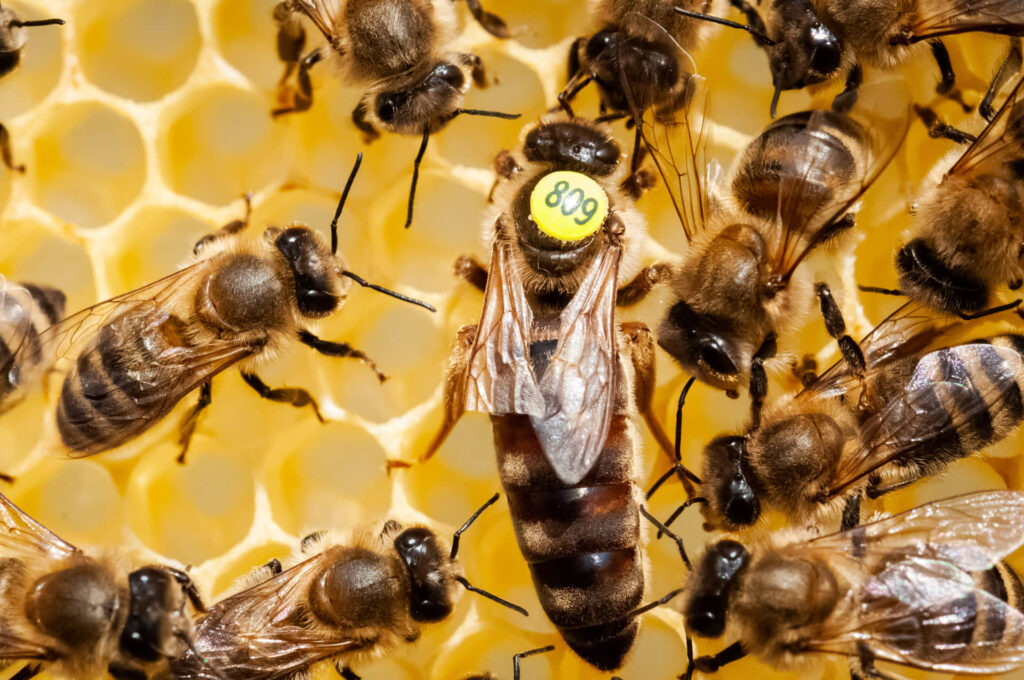
When you catch a glimpse of the queen among the clamor of worker bees, you may first notice her thorax: broader and sturdier-looking than that of a worker. Those strong flight muscles, housed in that thorax, give her the power to embark on mating flights early in her life. In addition, her abdomen stands out as noticeably longer, often tapering beyond her wing tips, giving the appearance of having shorter wings than other bees. A queen displaying these physical traits shows she is poised for abundant egg-laying, a crucial indicator of hive success. (Agriculture.Institute)
Though coloration alone can vary, a pale golden queen can be just as vigorous as her darker counterparts. What truly matters is how robust she looks and how actively she moves. The more vital she is, the better she can handle the high demands of laying eggs and maintaining order.
- Broad, developed thorax: Signals physical capability for necessary flights and daily tasks
- Long, tapered abdomen: Suggests strong reproductive potential and ample capacity for egg production
- Confident movement: Reflects her health and leadership, often drawing an attentive “royal court” of worker bees
- Smooth gait: Indicates she can navigate the comb with ease, essential for laying eggs in a stable, continuous pattern
Assess her brood pattern
Peek beneath the frames to discover a tapestry that reveals so much about your queen’s performance: the brood pattern. A compact band of eggs, larvae, and capped cells (often arranged in nearly concentric circles) means she’s laying systematically. You may see one egg neatly planted in the center of each cell, signifying precision and successful fertilization. This is a prime indicator that your queen is not only alive but also excelling in her role.
It’s common for a strong queen to lay between 1,500 and 2,000 eggs a day at the height of the season. (Agriculture.Institute) If you notice patches of brood with very few gaps, that points toward a fruitful hive where new worker bees grow predictably. In contrast, a spotty pattern may suggest a queen in decline or other issues, such as disease. Paying attention to these cells will help you gauge whether she’s actively nurturing the next generation or if it’s time to explore requeening.
On the days when you can’t spot your queen by eye, don’t worry—healthy brood is often proof enough. A consistent presence of eggs, larvae, and capped brood with minimal empty spots is like a handwritten note from the queen, telling you she’s busy fulfilling her role. Here, you may also want to refer to the queen bee’s role in the hive to better understand why her egg-laying consistency is so crucial to colony harmony.
Notice calm acceptance
You’ll know your hive is in sync when the workers around the queen behave with quiet devotion. Does she have a small circle of attendant bees grooming her, feeding her, and following closely? That retinue is known as the “royal court,” and it represents more than just a group of doting nurse bees. It’s a sign of acceptance—a stable relationship in which the queen’s pheromones keep the hive’s mood balanced.
Calmness in the colony also reflects her pheromone strength. Good pheromone production suppresses worker attempts to lay eggs and generally keeps everyone on task. Meanwhile, the queen’s steady composure during inspections—free of frantic scuttling or signs of aggression—indicates her confidence in ruling. This quiet harmony goes beyond a single inspection, laying the foundation for healthy honey production and thriving populations.
Guard against stress triggers
Like any living being, your queen thrives best in a stress-free habitat. Many environmental factors can disrupt a queen bee’s laying rhythm. Prolonged exposure to cold, sudden movement of frames, or repeated nighttime hive checks, to name a few. Over time, these disturbances could reduce her productivity or even lead to early supersedure by the worker bees. (The B Farm)
Ensuring your queen stays warm, undisturbed, and well-fed goes a long way toward sustaining her health. Whenever possible, minimize upheaval in her routine. Keep brood boxes positioned consistently and handle frames with slow, smooth movements. Even small courtesies, like avoiding multiple hive openings back to back, might be the difference between a bountiful brood pattern and a queen who struggles to keep pace.
Recognize cues for requeening
Queens inevitably age. As they do, their pheromone output weakens, and brood patterns become less consistent. You might find that the presence of too many empty cells in the middle of once-dense brood areas signals her declining fertility. Workers often notice this shift quickly, sometimes responding by constructing supersedure cells—special queen cells intended to produce her replacement. (The B Farm)
Even though it can feel disheartening to replace a once-productive queen, it’s a natural part of good beekeeping. By monitoring her performance and the signs of a healthy queen bee each season, you’ll develop a reassuring rhythm—one that protects your hive’s growth and ensures stable honey yields. When your colony’s new monarch takes her first steps across pristine wax comb, you’ll know that the cycle of renewal continues as it has for centuries.
In all of this, remember that a thriving queen isn’t just a single point of success. She’s the living pivot around which your entire colony spins, from the moment you open the hive to the day those foragers dance across your yard. Stay attentive to her body language, her brood pattern, and the subdued hum of a contented colony—and you’ll never miss those quiet but unmistakable clues that she’s right where she belongs.